Kinder Egg Firetruck
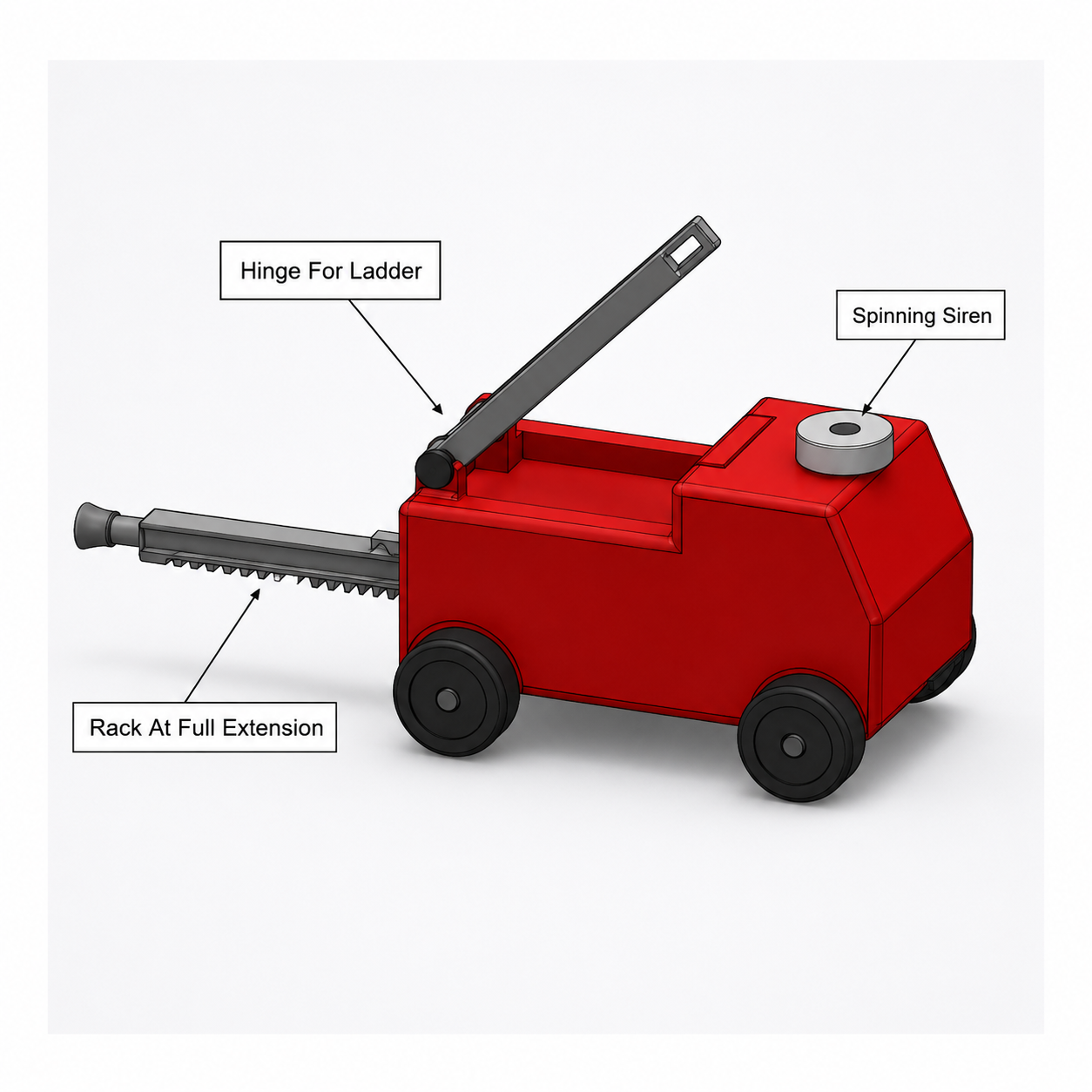
This project challenged our team to design, model, and manufacture a mechanically powered toy that fit entirely inside a Kinder Egg capsule while remaining safe, engaging, and manufacturable. The toy operated without electronics or batteries, relying solely on stored mechanical energy, and had to comply with Health Canada toy safety regulations.
The emergency-services theme guided both the mechanical function and the visual design, pushing us to balance engineering constraints with play value.
Team members: Callum Hallahan, Iknoor Braich, Namit Sharma, Emil Asadov, and Daniel Whelan.
Building Process
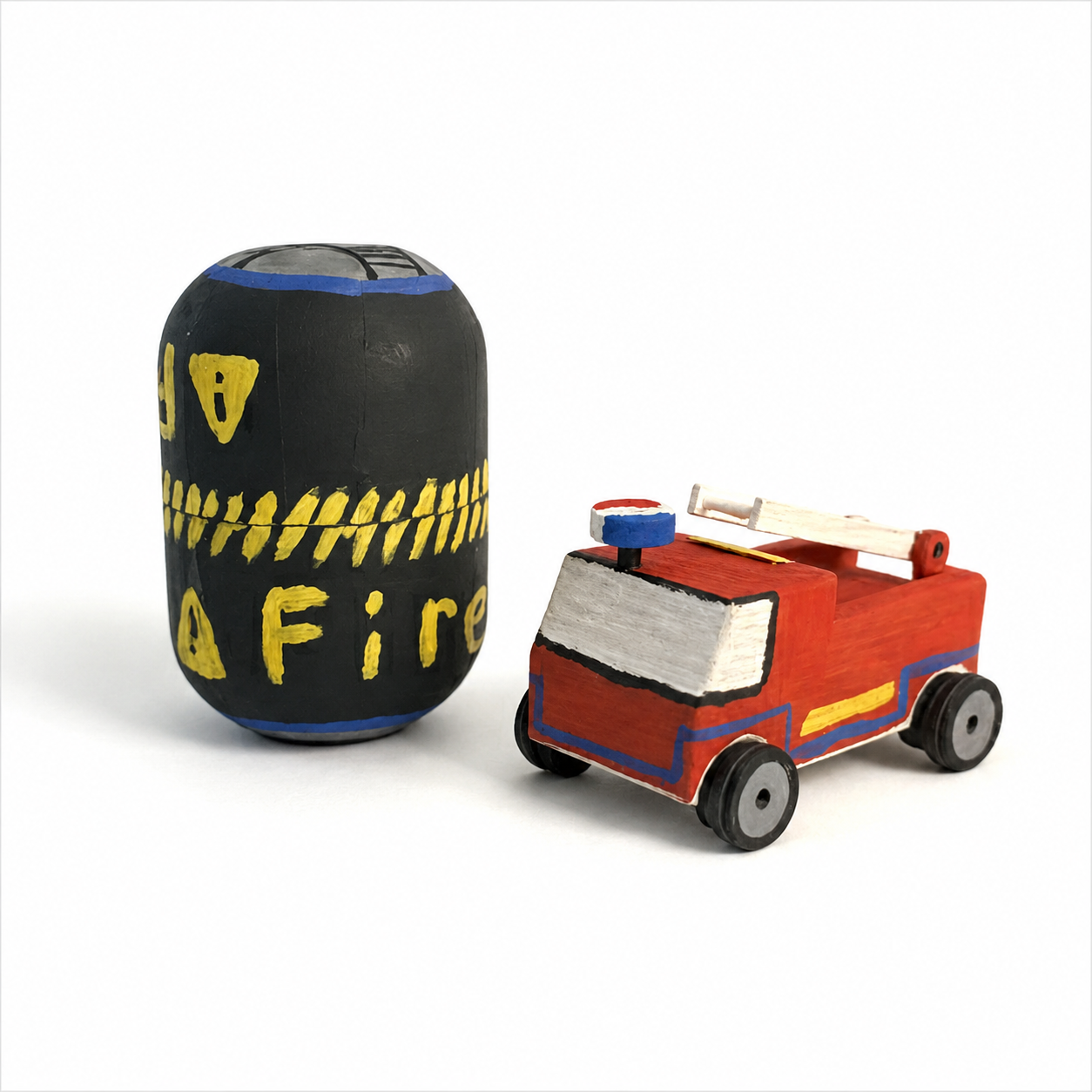
We developed the project over the course of the semester using a structured engineering design process that included problem definition, constraint analysis, concept generation, evaluation, prototyping, and testing. Our team brainstormed several toy concepts spanning different motion types and energy-storage mechanisms, then used a weighted decision matrix to select the most feasible option.
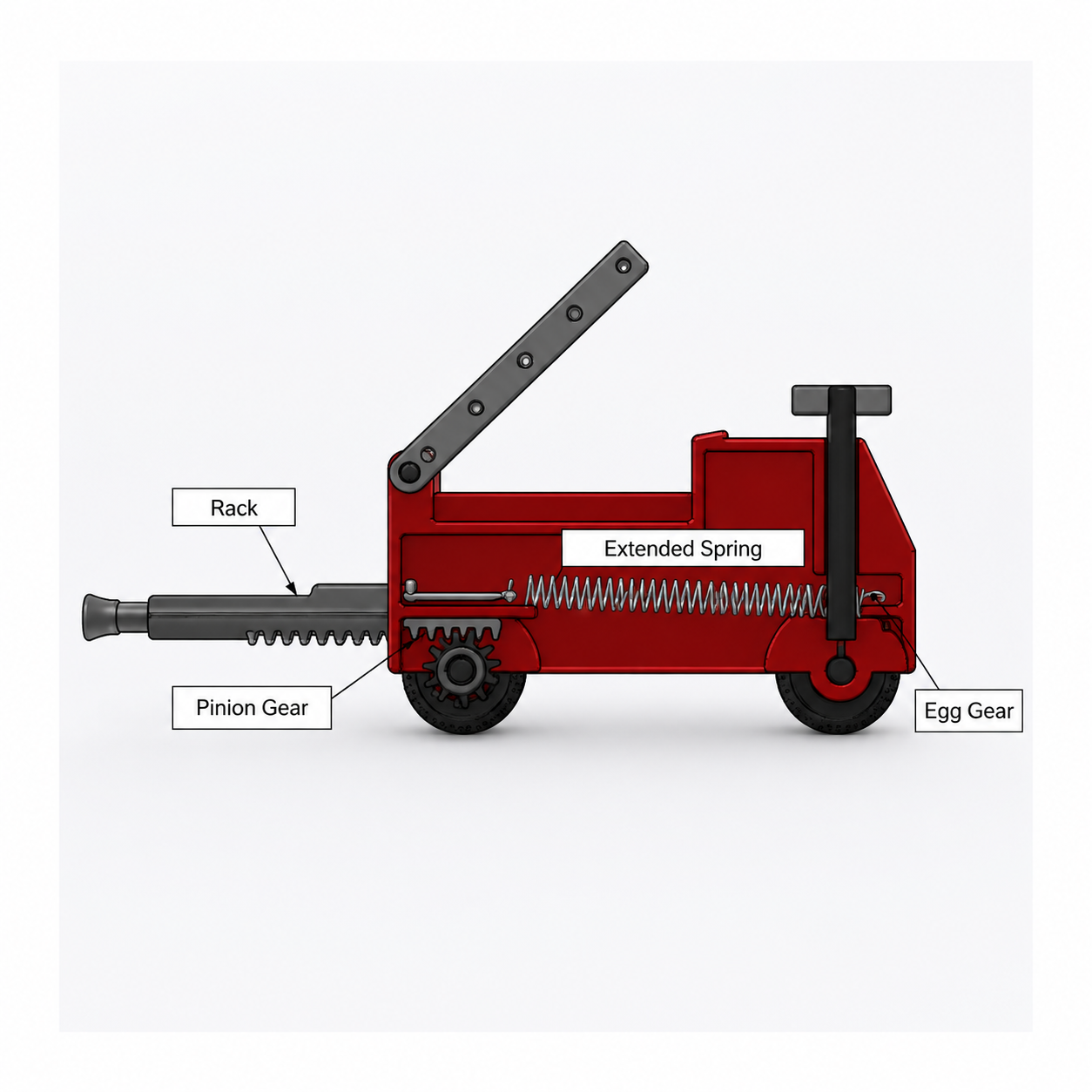
The chosen concept was a rack-and-pinion fire truck because it offered mechanical simplicity, reliability, and strong user interaction. All parts were modeled in SolidWorks with careful attention to tolerances, snap-fit joints, and rounded geometries to improve safety and repeatable assembly.
The prototype was manufactured primarily using ABS 3D printing and then refined through iterative testing to evaluate motion performance, friction, and durability. During this phase, we identified issues such as limited spring extension and friction from painted surfaces and adjusted the design accordingly.
Project planning tools such as Gantt charts, task delegation, and regular team check-ins helped keep the work on schedule and within budget.
What I Did
- Contributed to project management and scheduling to ensure milestones were met.
- Supported concept evaluation and selection using a weighted decision matrix.
- Assisted with mechanical design decisions related to the rack-and-pinion drive system.
- Participated in assembly and functional testing of the prototype.
- Helped identify and troubleshoot performance issues related to spring travel, friction, and tolerances.
- Contributed to documentation, reflection, and final reporting.
Engineering Analysis & Validation
- Verified mechanical energy transfer from the spring to the rack-and-pinion system.
- Evaluated assembly safety and usability for children using tool-free snap-fit joints.
- Assessed manufacturability through ABS print tolerances and part complexity.
- Supported cost analysis showing a low per-unit prototype cost of approximately $3.60 CAD.
- Reviewed environmental impact and mass-production feasibility using injection molding.
Key Takeaways
This project reinforced the importance of designing within real-world constraints, especially where safety, manufacturability, and user experience are tightly connected. Simplifying mechanisms proved more effective than overengineering, and early prototyping was critical in identifying tolerance and performance issues.
The experience strengthened my skills in mechanical design, DFMA principles, engineering decision-making, and team-based project execution, while showing how structured evaluation leads to better engineering outcomes.